


It’s well-known that legal systems are sedimentary, coming of age gradually with the societies they govern. As the American legal scholar Roscoe Pound famously put it: “The law must be stable, but it must not stand still.”
And yet, modern debates about emerging technology hardly ever treat the law as a dependent variable. We focus a great deal on data protection requirements, transparency obligations for AI models, and data center moratoria. But we ignore the extent to which technological disruptions shape, and reshape, legal systems across time.
I’ve been thinking about that bidirectionality a lot lately. If you understand the historical interdependence of technology and Western legal institutions, and you believe AI is likely to be transformational, you can’t help but wonder if even our most foundational laws may soon need a refresh.
Necessity Is the Mother of Reinvention
Back when Europe was mostly two peasants digging through slop, legal structures had to accommodate hyperlocalized social structures and chivalric notions of duty and privity. Vassals submitted themselves to their lords in public “homages”: Removing their hats, kneeling, placing their hands between their lords’, and exchanging a kiss on the cheek or lips.1 Meanwhile, victims of wrongdoing had to fit their grievances into strict formulas known as writs. If someone hit you, you could sue under the writ of trespass. If someone broke a contractual agreement that was under seal, you could sue under the writ of covenant. If no writ matched your grievance sufficiently closely, however, no legal recourse was available. That quaint foundation is why some areas of Western legal systems, like property, still sound downright medieval to this day. (Former law students will shudder at the mention of “life estates”, “equitable servitudes”, and whatever the plural of “fee simple subject to an executory limitation” is.)
Technological and social shifts during the Age of Sail and the Industrial Revolution demanded the law’s evolution, however. Mass production, steam power, and the proliferation of transportation networks introduced complex supply chains, physically and temporally alienating the manufacturer from the end consumer. Meanwhile, urbanization dramatically expanded the number and kind of interpersonal interactions anybody could have on a given day. Archaic legal institutions, with their emphasis on procedure and rigid obligations between long-acquainted individuals, couldn’t keep up.
In response, emerging nation-states slowly developed an array of new legal doctrines to promote commerce. Judges and legislators replaced the strict liability of the writ system with more flexible determinations of negligence predicated on “unreasonableness” and mushier standards of care. They looked to “foreseeability” of harm to sever the endless chain of economic liability that could arise from a single breach. They downplayed the idea of a “just price” in contracts, often deferring to the parties so long as a procedurally fair “meeting of the minds” had occurred. Maybe most importantly, they invented the modern corporation with limited liability and derivative fiduciary duties, giving entrepreneurs the ability to take risks and investors the confidence to finance them. The fields of corporate law, contracts, and torts as we know them today owe a great deal to these developments.
Modern intellectual property protections are the result of a similar reckoning. For most of human history, copies of text or imagery didn’t need to be regulated; transcription was the hard part. Then, the printing press slashed the marginal costs of publication. Afraid of texts endorsing heresy or treason, monarchs in the Age of Absolutism began granting time-limited printing monopolies to trusted publishers’ guilds. Over time, however, Parliament grew wary of guilds’ outsize influence and monarchs’ censorship. So in 1710, it passed the world’s first modern copyright law, the Statute of Anne, transferring monopoly rights from the guilds to authors themselves.
A few generations on, the drafters of the Constitution recognized the link between intellectual property protections and innovation. The copyright clause in Article I, Section 8 is the sole enumerated power that identifies a specific, built-in justification: “To promote the Progress of Science and useful Arts”. Over the course of the next century, American courts stretched IP regimes to cover new forms of media like photography, while legislators passed the first modern trademark laws to distinguish high-quality brands.
Even modern technologies have forced institutional rebirth. Consider the United States over the past 150 years. Following its invention in 1874, barbed wire was often called “the devil’s rope” for accelerating the end of cattle drives, the closing of the American frontier, and the expansion of property rights in the West. Samuel Warren was so annoyed by yellow journalism and the use of Kodak cameras at social functions that he and Louis Brandeis wrote a seminal 1890 essay called “The Right to Privacy”, providing a foundation for modern privacy law. Modern antitrust laws and labor protections like workers’ compensation schemes were largely a response to Gilded Age excesses and new classes of injury inflicted during the Second Industrial Revolution. When a North Carolina farmer sued the government in 1946 because military planes were scaring his chickens to death, the Supreme Court ruled that the age-old ad coelum doctrine — “Whoever owns the soil, it is theirs up to heaven and down to hell” — had “no place in the modern world.” In the postwar era, exposés like Unsafe at Any Speed and Silent Spring spawned new consumer welfare protections like mandatory seatbelt laws and pesticide bans. And when the internet unleashed an astonishing array of digital assets and dubious peer-to-peer tools like Napster to share them, courts had to balance protections for creators and preservation of the digital public square.
In each of those cases, technology shaped the law at least as much as the law shaped technology. As Neil Postman wrote:
Introduce the alphabet to a culture and you change its cognitive habits, its social relations, its notions of community, history and religion. Introduce the printing press with movable type, and you do the same. Introduce speed-of-light transmission of images and you make a cultural revolution. Without a vote. Without polemics. Without guerrilla resistance.
Prediction’s Tough (and I’ll Give It a Crack Anyway)
Now we’re caught up, and the obvious question is this: How might AI strain legal systems in the future?
It’s hard to accurately predict the costs and benefits of a new technology, and harder still to forecast what that technology might do to downstream regulatory and judicial institutions. When the Department of Defense introduced GPS in 1973, no one could have foreseen Uber, or designed a robust legal regime for taxicab displacement and the gig economy. Nor is it always clear in the moment what’s happening to the legal field: It wasn’t until the late 19th century that law professors retroactively delineated substantive doctrines like contracts, torts, and property.
If I were working at the Department of Justice or in the judiciary today, I’d therefore stress humility. The law may be sedimentary, but it’s also sticky. As a general rule, we should let legal systems evolve when they must, how they must.
Since I’m not in government, though, I can speculate to my heart’s content about what comes next. AI does seem poised to disrupt a number of foundational legal doctrines:
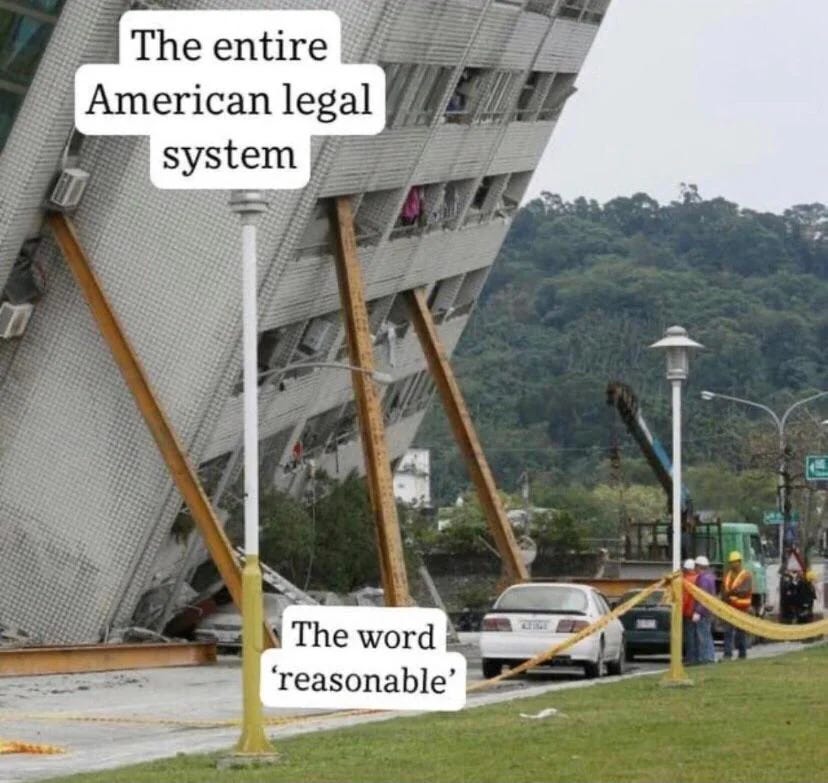
What’s “reasonable” in the context of tort law? If diagnostic equipment is more accurate than a human doctor, is it negligent for that doctor to overrule a model?
Relatedly, what’s foreseeable? To what extent can human operators be accountable for the tortious consequences of black boxes?
Is an AI model a product, triggering strict liability? A service and information platform, justifying a negligence standard and libel laws? Or something else entirely? (Section 230, which limits online platforms’ liability for what users post and allows for the internet as we now know it, likely doesn’t apply to model developers.)
How will agents change the “guilty mind” requirement and intent in criminal law? If a misaligned model synthesizes a biological weapon, where does liability fall between developer, distributor, and user?
How can a contract negotiation result in a meeting of the minds if one or both parties rely on agents? When and how can an agent legally bind a user?
Copyright law traditionally protects expression of an idea rather than the idea itself, and relies on substantial similarity when testing for infringement. Can either principle survive in the AI era, when expression is easy and different prompts generate similar results?
Given how ubiquitous and powerful models might be, how should courts contemplate damages? Models are already ubiquitous, and the potential threat to innovation is vast. Could alternative dispute resolution schemes like no-fault compensation be possible in some sectors?
What will become of state-backed licensing regimes when anyone can use a model to self-diagnose or present a competent legal defense?
How will evidentiary standards in criminal trials evolve as deepfakes become more convincing? “Pictorial testimony” often requires a human witness to express knowledge of authenticity, but deepfakes may increasingly contaminate memory.
I’m no doubt missing others.
I want to write about some of those topics in the future, and to explore the related question of what emerging technologies will do to nation-states. For now, though, I’ll just say this: Robust legal regimes don’t spring from an expert’s temple fully formed. They’re necessarily iterative, and necessarily susceptible to technological disruption. In that sense, the law is not just the hammer; it’s also the nail.
Homage is the only truly perfect social system, and we are worse for its absence today.