


Something odd is happening in the developed world. We’re better off than at any other point in human history: Stomachs full, minds free, lifespans long. And yet, large parts of the population spend a lot of time worrying about the future. Factions ranging from AI doomers to NIMBYs aren’t satisfied with the world as it is; but they also don’t trust others to do something about it.
It’s one thing to be thoughtful about how a culture engages with new technologies and social shifts. But we’re fixating on every possible negative contingency, delaying or denying a more abstract upside in the process. Modern philosophy is lopsided that way. We protect the past from the future, not the future from the past.
Why does that matter? At the cultural level, optimism is strategic advantage. If you believe you can do amazing things, you can do amazing things.
On the other hand, if you’re always scared of the monsters under the bed, you never quite grow up.
Dead Kids and Short Attention Spans
I know firsthand the importance of cultural ambition. I’m alive today because of it.
Ordinarily, a pulmonary valve has flaps that open and close smoothly with every heartbeat, forcing blood to the lungs. But in about one out of every two thousand babies, the valve comes out wrong: Narrow, misshapen, unable to circulate blood as it should. Doctors call it pulmonary stenosis.
For the vast majority of human history, little could be done for an afflicted child. Premodern physicians would simply diagnose a baby’s blue skin as a humour imbalance. Doctors in the mid-1800s would try to keep the child warm and sedated, often using opiates to try to conserve oxygen. Truth is, it didn’t matter what you did. A baby with severe pulmonary stenosis was usually dead in a few months.
You’ve probably never heard of pulmonary stenosis, though, because we developed a way to beat it. In 1982, researchers pioneered a new procedure called balloon valvuloplasty. Doctors could now tear open the fused valve by threading a catheter up through a vein in the groin and momentarily inflating a balloon in the heart. Today, well over 99% of babies with pulmonary stenosis survive.
In 1999, I was born with one of those narrow, misshapen valves.1 If not for balloon valvuloplasty’s invention a mere 17 years before my birth, a poorly read Substack wouldn’t exist today.
I tell that story not because it’s unique. The opposite, in fact. Social problems like pulmonary stenosis are a fact of life — until they aren’t.
The scale of childhood mortality in the premodern world is utterly unfathomable today. When diarrhea, pneumonia, measles, smallpox, malnutrition, malaria, malnutrition, and congenital conditions were barely treatable, roughly a quarter of babies died before turning one. Nearly half of kids who’ve ever lived never reached adulthood. And sometimes the odds were even worse than that. That was life, though.2 People didn’t know any other.
Now, no matter where you look, child mortality is historically rare:
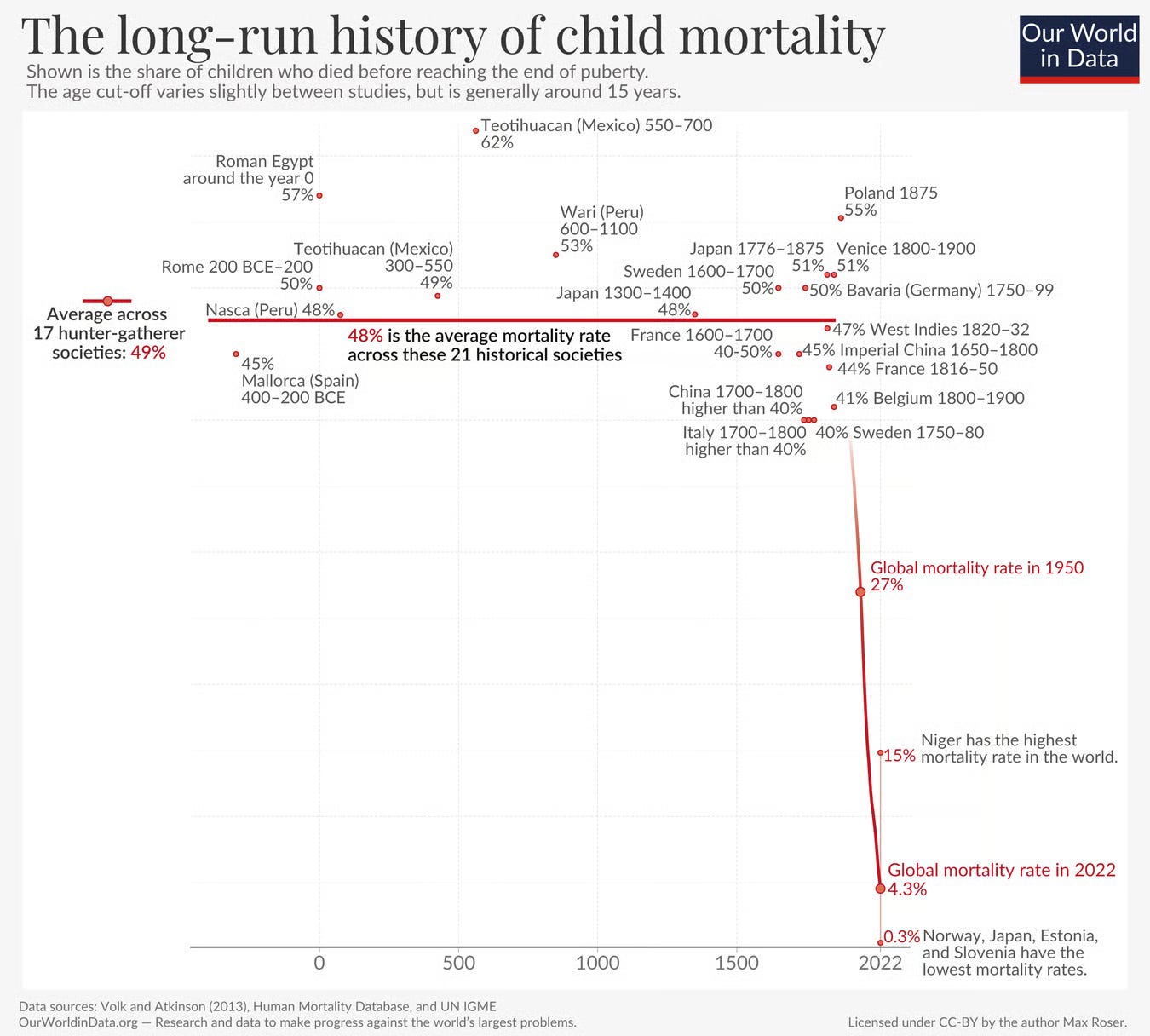
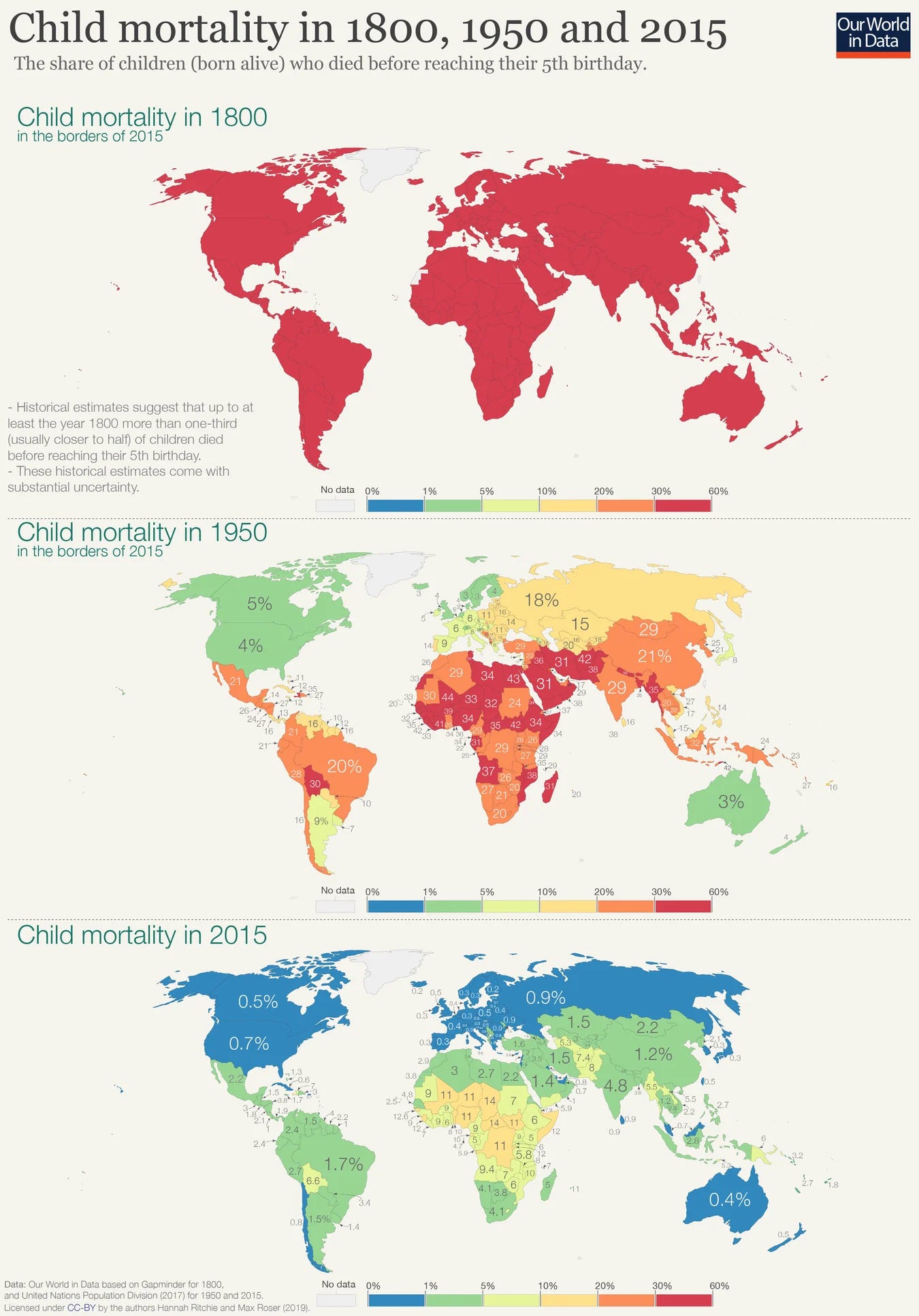
That shift is on the shortlist of greatest developments of all time. By my calculation, if kids born today faced the odds of 1800, over 50 million more would die annually. A newspaper could accurately run the headline “140,000 Children Didn’t Die Yesterday” every single day.
Today, though, we hardly think about that progress or how it happened. Instead, we take for granted a wide range of public health improvements: Germ theory and antisepsis, vaccination campaigns, municipal water systems, antibiotics, nutritional science, Pasteurization, public education, expansion of humanitarian aid, global trade, and the dull social and political institutions needed to make the system go. Pioneering scientists and humanitarians were a huge part of the story.3 But equally important was a culture that supported them.
What happens when a culture is hostile to change? In the 1800s, a Hungarian obstetrician named Ignaz Semmelweis noticed that mothers who delivered babies in a clinic staffed by doctors were far more likely to die of childbed fever than those in a clinic operated by midwives. Realizing that doctors often delivered a child immediately after an autopsy, Semmelweis hypothesized that “cadaverous particles” could be transferred between bodies. When he ordered his staff to disinfect their hands before delivering a baby, mortality plummeted.
Naturally, Semmelweis was ridiculed by peers. At a time when germ theory was still decades away, Semmelweis had contradicted basic principles of the medical establishment. Worse, he’d dared to imply that a gentleman’s hands could be unclean. After being ostracized, Semmelweis took to drinking, suffered a nervous breakdown, and was committed to an insane asylum where he was beaten by guards. Two weeks later, Semmelweis died of an infected wound — the same thing he’d spent his career fighting.
Dissenting voices may not have to worry about institutionalization today. Childhood mortality is not such an issue anymore. Still, we face enormous, and preventable, social challenges. Yet we have a modern “Semmelweis reflex” problem on our hands: Key players across the developed world reject transformative technologies and practices if they contradict custom. In a sense, we’ve actually democratized resistance to social change, while grandfathering in the wickedness of the world.
Distrust the Process
What do I mean by that? There’s arguably never been such widespread pessimism in public life, nor so many motivated veto players. Trust in public and private institutions has plummeted since the 1970s:
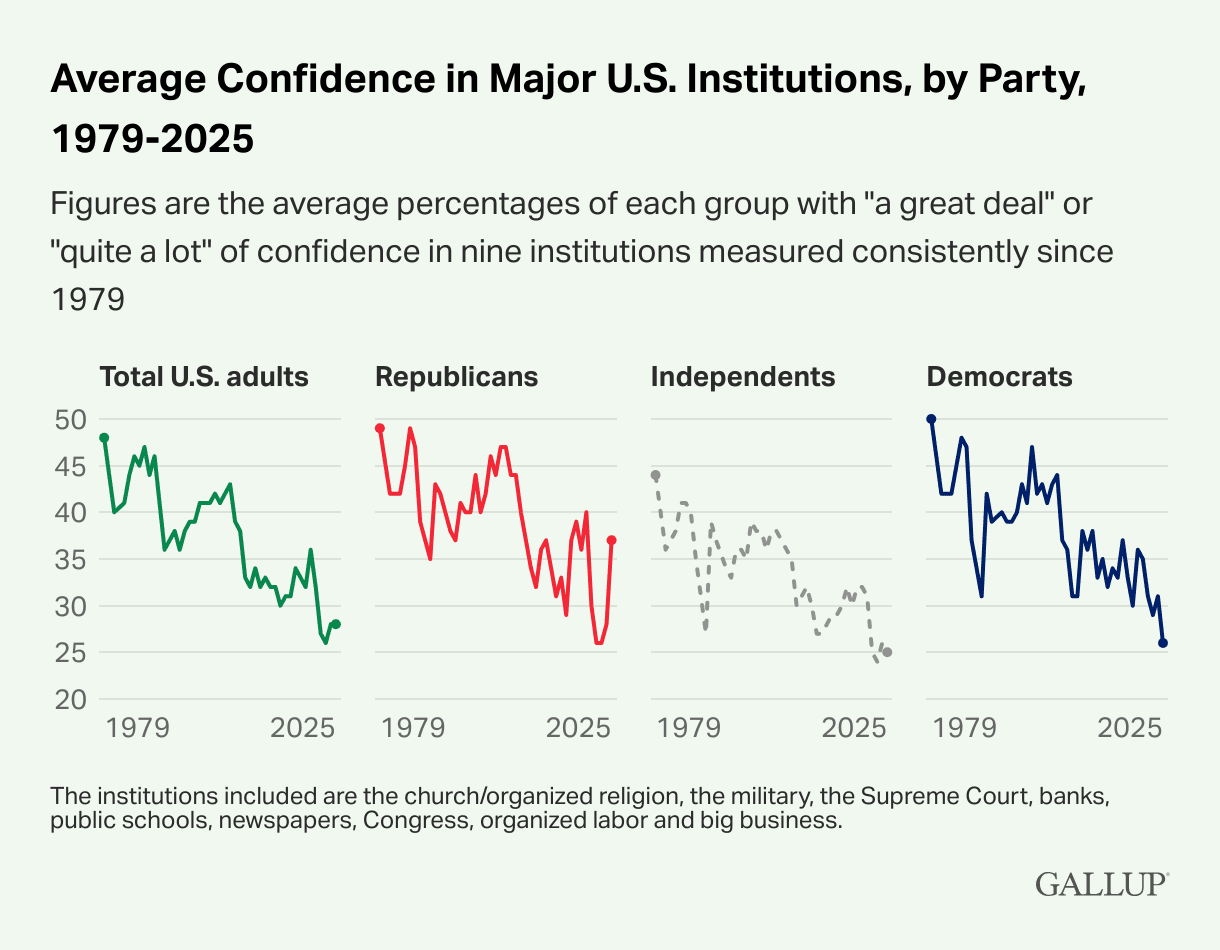
Faith in the medical system, tech sector, and even “science” are also cratering.
Partly as a result, in recent years new technologies and social initiatives have served as an outlet for public distrust and anxiety. NIMBYs and environmental activists sue to delay infrastructure projects indefinitely. Many voters treat AI and data center development with a scorn once reserved for climate change. Community organizers block the buses used by San Franciscan tech workers, for reasons I still can’t understand. Vandals toss Lime scooters into the ocean. Taxi drivers protest Uber. Uber drivers protest Waymo. Anti-vaxxers trade on occasionally overreaching COVID lockdowns to cast doubt on inoculation more generally. And degrowthers push back on just about anything new. The public is as politically engaged as it’s ever been; and public discourse has rarely been so cynical.
Worse, public sector institutions in open societies have responded by redirecting their focus from innovation to regulation. Federally funded R&D in the United States dropped from a peak of 1.86% of GDP in 1964 to just 0.63% in 2022. European politicians have often applied the “precautionary principle” — the idea that any policy that may cause harm and that lacks scientific consensus should not be pursued — to justify their burdensome digital regime. German legislators shut down the country’s entire nuclear grid after Fukushima, replacing much of the lost power with coal and costing 1,100 lives a year in the process. And regulators responded to Greenpeace’s anti-GMO advocacy by blocking the use of Vitamin A-rich “Golden Rice” across the developing world, allowing hundreds of thousands of kids to die or go blind in the interim.
There’s no single explanation for this new era of mass pessimism. Certainly, our preference for nonfeasance over misfeasance is part of the story: An FDA reviewer who approves a single harmful drug may end up before Congress, while a reviewer who delays ten life-saving drugs goes back to work the next day. The twin crises of Vietnam and Watergate also hurt, starting a decades-long slide toward the belief that government associated institutions are the problem, not the solution. More sophisticated political organizations have weaponized negative partisanship and wedge issues in the last half-century. The 24-hour news cycle amplifies negativity.4 The lack of a foreign enemy like the Soviet Union empowered single-issue domestic tribes, each with some ability to block the others’ policy agendas. And even our lawyerly political style may contribute.
The World’s Oldest Bargain
Whatever the reason, as someone who owes his life to scientific innovation, I find the moral panic deeply depressing. Part of the problem is that future technological and social achievement is too vague to attract a constituency. Well, let me try to balance out the doom-and-gloom. Here’s a list of transformative social developments that are at least reasonably likely in just the next decade or two:
The return of space travel, facilitated by robots making extraterrestrial life more hospitable for humans;
Renewable energy resources that are both more economical and cleaner than fossil fuels, solving centuries-old collective action problems;
Government services made far more efficient at the point where most people actually engage with them (as the Ukrainians have already demonstrated, even under fire);
Solutions to even more of the world’s hardest math problems — progress assumed by many to be impossible just months ago — with downstream effects in fields ranging from engineering to contract negotiation;
Robots that free us from the most grueling, unpleasant jobs, including labor-intensive agriculture and manufacturing;
Bespoke gene therapies;
Vastly better materials science, meaning better batteries, aerospace equipment, or even artificial organs;
The creation of new organisms that can neutralize harmful bacteria;
Consciousness research that helps us better understand one of the great remaining mysteries of the cosmos;
Biotechnological and logistical improvements that translate to significantly better and healthier food;
Individualized AI tutoring, dramatically accelerating the traditional learning cycle;
Urban transportation and fleets of driverless cars that help us redesign our cities and avert tens of thousands of needless deaths a year;
Quantum systems that revolutionize computation, possibly allowing us to harness fusion reactions (and at last making energy “too cheap to meter”);
Better water access thanks to those energy improvements, since desalination’s primary bottleneck is the energy input; and
Brain-computer interfaces that allow humans to learn, share, and connect in ways never before possible.
In the same breath, of course, I could rattle off a bunch of potential harms. AI psychosis, antisocial behavior, digital authoritarianism and surveillance, engineered pathogens, job displacement, “Q-Day” cryptographic breaches, and the militarization of space all come to mind. You can’t have the good without some of the bad: The most useful applications of emerging technologies are also often the most dangerous.
If that’s the case, should we all just stay home?
In Searching for Safety, Aaron Wildavsky argues that a society can choose how it responds to risk. It can bet on its own resilience, acknowledging that bad things will happen and adapting accordingly. Or it can try to anticipate every harm, pumping the brakes early and often. Betting on resilience is scary, Wildavsky acknowledges; but world-changing projects require ambition, adaptability, and sometimes even failure. If we don’t try, and fail, and try some more, society stalls. As Wildavsky writes: “The secret of safety lies in danger.”
Hold on to That Feeling
A single blog post won’t cure a case of cultural pessimism. (Probably.) That said, a few principles would help us contemplate risk a little more thoughtfully.
Restrict the harmful outputs of new social and technological institutions — not the inputs. The social contract works better when we allow society to evolve organically instead of trying to get too far ahead of change.
Government policy needs more expiration dates. By default, laws and regulations that deal with emerging technologies should sunset to minimize the likelihood of unintended consequences. We should trust future decision-makers to address problems that persist into the future.
Save preemptive action for significant and irreversible damage. In most cases, it’s okay to wait on regulation when we don’t know how an underlying technology will evolve. Even where existential or catastrophic risks justify preemptive action, we have to be honest about what actually helps. As I wrote a few weeks back, a global AI development slowdown doesn’t pass muster.
Acknowledge future upside, even (or especially) when it’s hard to estimate. The Iroquois require that major decisions made today contribute to a sustainable, just world seven generations in the future. Policymakers weighing regulation of emerging technologies should simultaneously consider existing social harms and how the tech might help.
Appreciate disruption. In The Structure of Scientific Revolutions, Thomas Kuhn documents how the most significant scientific breakthroughs often result from upheaval. It’s comforting to grab hold of something familiar when we’re disoriented, but it’s not a winning long-term play.
To be ambitious, a culture has to first believe that a better future is possible. It has to watch “The Jetsons”, not “Black Mirror”. It has to build monuments to progress, like Disney’s Tomorrowland. Most of all, it has to accept that technologies and social systems will evolve beyond anyone’s control, in ways good, bad, and neutral.
None of that is easy. Even I, obnoxious techno-optimist that I am, find it hard to focus on intangible future benefits sometimes.
But it gets a little easier when I think of a little boy with a stubborn heart.
Last week, I learned that I can’t donate stem cells due to the condition. So instead I’ll make a pitch to you: Stem cells are much more useful than a standard blood donation. You can, and should, sign up here.
Treatment outcomes varied with income, but only so much. In 1924 Calvin Coolidge, Jr. developed a blister on his foot while playing tennis at the White House. He’d been playing without socks, as was the fashion. After sepsis set in, the son of the most powerful man in the world died of a condition he could’ve treated with modern antibiotics for a few bucks.
This is a good opportunity to plug my favorite website: https://scienceheroes.com/.